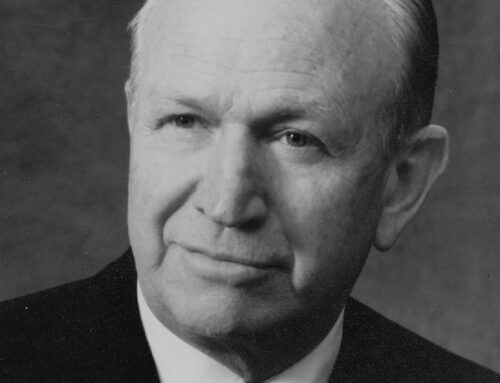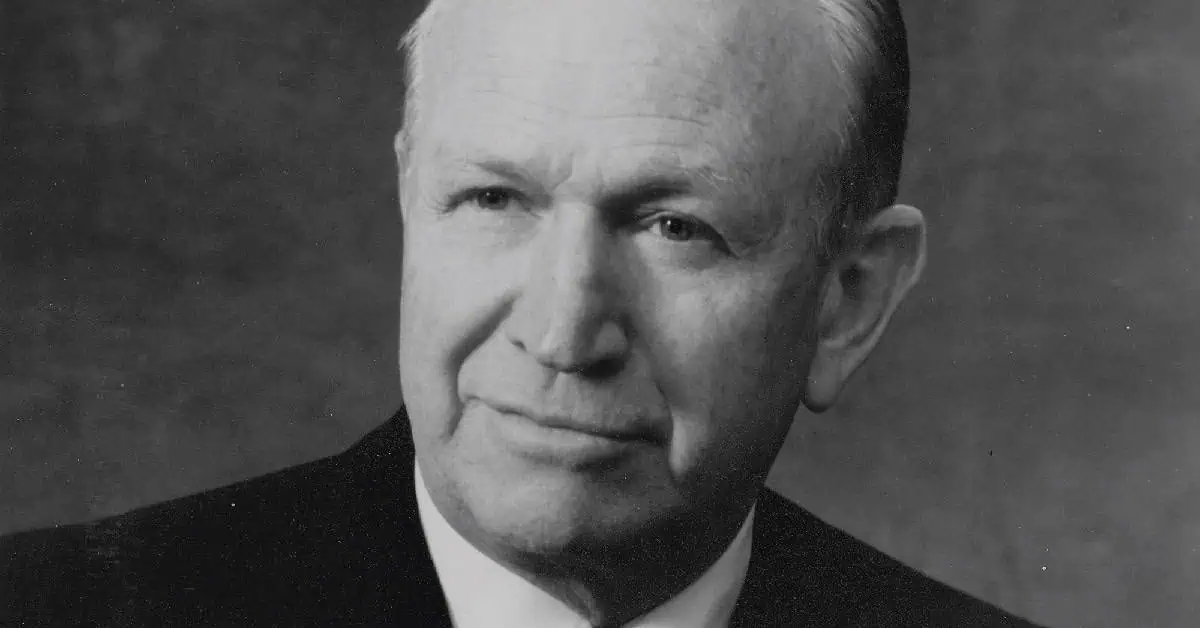

Our American Originals series of biographies has focused on men and women who started or built large enterprises that touched the lives of millions, often creating thousands of jobs. Yet, there have also been entrepreneurs at work in “smaller fields” who nevertheless have had a huge impact on the world around us and the quality of our lives.
Among the greatest of those men was Daniel Burnham, who gave us or helped develop the organized large architectural firm (no longer dependent on the skills of just one person), the layout of the modern office building and the greatest of the world’s retail stores, stunning tourist experiences like a World’s Fair, the development of the modern steel-frame skyscrapers, the modern city-planning profession, and much else. This is his story.
Beginnings
Daniel Hudson Burnham’s ancestors, of English heritage, first arrived in America in Massachusetts in 1635. By the nineteenth century, they had moved west. Dan’s father, Edwin Burnham, then seven years old, moved to Henderson, New York, near Lake Ontario, with his family in 1811. In 1832, he married Elizabeth Weeks, the daughter of the Reverend Holland Weeks. Reverend Weeks had been a Congregationalist minister but was excommunicated due to his belief in the ideas of Swedish scientist and theologian Emanuel Swedenborg. Weeks and Edwin and Elizabeth Burnham became active in the Swedenborgian “New Church,” a somewhat mystical Christian sect with emphasis on the “inner self,” doing good works, and serving others. Burnham biographer Thomas Hines stated, “Spiritually, ethically, intellectually, and socially, the Swedenborg faith pervaded the Burnham household.”
Edwin Burnham moved the family to Detroit where he helped organize a New Church there, then he returned to Henderson in 1840, where he was an unsuccessful shopkeeper. Daniel Hudson Burnham, the fifth of six children and the youngest son, arrived on September 4, 1846.
Despite modest means, the Burnham home was filled with reading and music, with a focus on intellectual and religious development. The family read the works of Swedenborg each day. Dan’s mother, Elizabeth, was “full of wit, open-minded, and fun-loving” but also placed great emphasis on exercise and health, which became lifelong obsessions for Dan. His sister said that Dan received from his mother, “courage, progressiveness, clear judgment, ready sympathy, sincerity, and trustfulness.” Dan Burnham became and would remain a devoted student of Swedenborg his entire life.

The Burnham family remained in Henderson, in large part so that Elizabeth could care for her ailing father, Reverend Weeks. In 1854, Weeks died, and the family felt free to relocate in search of better opportunities. Edwin wanted to move to nearby Rome, New York, but was convinced by his wife to try Chicago, where his brother had become a successful lawyer. Leaving his family behind, Edwin failed to succeed in Chicago and was eager to return to Henderson. But strong-willed Elizabeth stopped him by shipping the children off to Chicago, settling the issue of where the family would live.
In the second half of the nineteenth century, Chicago was probably the largest and fastest-growing “boomtown” the world had ever seen. In 1850, Chicago had a population of about 30,000, one-twentieth the size of the combined cities of New York and Brooklyn, which did not merge until 1898. Chicago was the twenty-fourth-largest U.S. urban area, about the same size as Lowell, Massachusetts, or Troy, New York. Everyone knew that the city had a great future, as the westernmost of the cities arising west of the Alleghenies, but still smaller than New Orleans, Cincinnati, St. Louis, Pittsburgh, or Louisville.
A decade later, in 1860, Chicago was becoming the railroad center of America and had risen to be the ninth-largest city, with a population of 112,000. By 1890, Chicago’s population would explode to 1.7 million, the nation’s second-largest city. Chicago was then roughly equal to the combined populations of New Orleans, Cincinnati, St. Louis, Pittsburgh, and Louisville. Eight-year-old Dan Burnham and his family arrived in Chicago just as this great boom was beginning.
In Chicago, Edwin Burnham finally found success as a partner in the wholesale drug and paint business. The family at last began to live “a comfortable life.” Young Dan attended Snow’s Swedenborgian Academy and public schools. In 1861, Dan caught the war fever and tried to join the Union Army, but his father stopped the 15-year-old. At Central High School, the “tall, big for his age, handsome” Dan excelled in art and athletics but not in scholarship. He rarely studied and was censured for his negligence. Never without a pencil in his hand, he annoyed teachers by drawing when he should be studying (like the young Walt Disney). At the same time, Dan was a natural leader, organizing the other students (and getting them out of class) when it came time to decorate the school for holidays and special events. Dan also took private drawing lessons with Miss Starr; like others who influenced him, she remained a lifelong friend.
By 1865, Edwin Burnham’s fortunes had risen enough that he was elected president of the Chicago Mercantile Association, and as a result, the family’s social circle expanded. Edwin and Elizabeth expected Dan to go to Harvard, and in 1863, they sent the 17-year-old east to a Massachusetts prep school. Despite being well-tutored and prepared, Dan failed the Harvard entrance exams. Perhaps due to his parents’ high expectations, he froze at test time, saying he “could not write a word.” He also failed to get into Yale. He understood what it meant to be a scholar, and he was not one.
In 1867, Dan returned to Chicago but was discouraged and restless. He tried being a salesman. But he also remembered enjoying the study of architecture when he was back east and the next year took a job as a draftsman apprentice at the architecture firm of Loring and Jenney. (William Le Baron Jenney would go on to be a pioneer in the development of the steel-frame skyscraper with his Home Insurance building in Chicago in 1885.) Dan’s enthusiasm for architecture gained strength, and the challenged but ambitious 22-year-old wrote his mother, “I shall try to become the greatest architect in the city or country. Nothing less will be near the mark I have set for myself.”
Nevertheless, Dan was still restless, still looking for opportunities. He quit the job and ventured west with a friend to try his hand at silver mining in Nevada. While the mining venture did not succeed, Dan ran for the Nevada state senate as a Democrat and lost, ending any interest in running for office. Dan went on to become a lifelong Republican, primarily of the Teddy Roosevelt “progressive” bent. Yet he was always wise in his dealing with politicians of all stripes, maintaining friendships and alliances in order to achieve his goals and dreams. Chicago political boss “Bathhouse John” Coughlin even named a racehorse “Burnham.”
At 24, Dan Burnham had failed in the east and failed in the west and returned to Chicago, where he worked briefly in various architectural offices, giving the profession another try. He noted that “there is a family tendency to get tired of doing the same thing very long.” But Dan was impatient for success.
In 1872, at age 26, Dan joined the Chicago architecture firm of Carter, Drake, and Wight. The great Chicago fire in October 1871 had destroyed 17,000 buildings and left 100,000 people homeless. So, it was a great time to be a Chicago architect. Whether by luck, planning, or fate, this job would change Dan Burnham’s life.
Meeting People Who Changed Dan’s Life
At the firm, Dan began to find himself, to have more direction in life. The people he met changed that life. Partner Peter Wight, an architectural scholar, became his mentor. Dan later said that he owed more to Wight than anyone else in his development as an architect. Under Wight’s influence and with his own failures in the east, Dan also developed an almost unhealthy “reverence for academic authority.” Over time, he looked back on his early years as a great waste and encouraged his own sons to be more focused at that stage of their lives. He also became a great supporter of the same eastern institutions he had failed to enter, especially Harvard.
Even more important in the Dan Burnham story is that at Carter, Drake, and Wight, he met John Wellborn Root, who was four years younger than he. Root came from a prosperous Georgia family. He had spent the Civil War going to school in England. At war’s end, his parents brought him home, and in 1869, he graduated from New York University in engineering with honors, at the age of 19. Root worked for some of the most prominent architects in New York, including James Renwick who designed St. Patrick’s Cathedral. Root then went west to benefit from the rebuilding of Chicago, and in 1872, the same year Dan joined the firm, he became chief draftsman at Carter, Drake, and Wight, and in effect, Dan’s boss.
John Root was an exceptional talent: well-educated, quick-witted, and comfortable with friends but shy around strangers, unlike the extroverted Dan Burnham. But like Dan in his earlier days, he often lacked direction. His varied interests “often became distractions and excuses for procrastination.” John did not share Dan’s intensity of ambition. But both loved drawing and architecture, as well as music. (John was a very accomplished church organist.)
Dan and John soon became fast friends. The two men talked for long hours about forming their own architecture firm. In 1873, they quit Carter, Drake, and Wight and began their own, Burnham and Root. Dan “resolved from the first that the new firm should lead the profession and never flinched from that purpose.” Dan and John were 27 and 23 years old, respectively.

Daniel Burnham and John Wellborn Root
Nevertheless, business started slowly for the new firm, due to the recession of 1873. The two worked part-time for other firms to put food on the table. They bought drafting paper a few yards at a time and kept the fireplace going to keep their drawing fingers from freezing.
In 1874, the wealthy John B. Sherman, who made his money on the enormous Chicago stockyards as the city became the meatpacking center of the nation, decided to build a new mansion for his family. A friend of Sherman’s suggested he consider the young firm of Burnham and Root, and they got the job, which brought the next key person into Dan’s life. Sherman’s daughter, Margaret, “fell in love with Burnham at first sight.” Dan and Margaret got engaged before the $30,000 Sherman house (about $900,000 in 2025 money) was completed.

John B. Sherman House, 2100 South Prairie Avenue, Chicago
When Margaret was traveling with and taking care of her sick mother, she wrote to Dan wishing to return to Chicago and see him. Dan wrote back that this was an opportunity for self-denial, a chance to put others above oneself, saying, “We live to overcome selfishness.” When Dan’s brother, Edwin Jr., forged checks and scarred his family with scandal, Dan went to John Sherman and offered to break off their engagement, but Sherman appreciated his honesty and backed the marriage. Dan’s Swedenborgian ethical values never wavered. The two were married on January 20, 1876, in the Sherman mansion. Dan was 30, and Margaret was 26. Their mutual love, reflected in many letters, lasted until the day Dan died.
The connection to the powerful John Sherman and his friends led to both a widening social circle for Dan and to a flood of work for Burnham and Root. They designed and built homes for some of Chicago’s most important citizens, including journalists Victor Lawson and Henry Demarest Lloyd, composer and music critic Reginal de Koven, painter George Healey, General Philip Sheridan, and business leaders Charles Hutchinson and Edward Ayer. Dan did the things John did not enjoy: shaking hands, talking, lunching, explaining, convincing, and reassuring their clients. They rented a larger office for $700 per month, such a large expense keeping Dan awake at night. Yet, the business boomed. Dan wrote that “before seven years were over fortune had smiled on us.”
Over the 18 years following the formation of the firm, Burnham and Root designed and built over $40 million worth of homes, office buildings, churches, schools, train stations, hotels, warehouses, retail stores, and hospitals. They even created casinos, barns, convents, and monuments. While John was “amply content to sit in the inner office, aloof from the boresome talkers, and do his work,” Dan was out “selling” the firm, seeking big opportunities and large projects. Both men had outstanding design skills and vivid imaginations, but Dan had enough ambition for the both of them—and the willingness to go wherever and meet whomever in order to succeed, in order to do “big things.”
Shaping the Architecture Profession and the Chicago Skyline
Dan Burnham and John Root made an ideal team. When they received a commission, Dan would first lay out the building, designing the basic floor plans of the ground and upper floors. He would do several alternative sketches, which the partners would discuss. Then John went to work, “decorating” the building but also setting the whole feel of the exterior street view, with Burnham continually commenting and adding ideas or suggesting changes. Often, John would object but later realize that Dan had the better idea. Dan would urge John to delegate routine tasks, but John was unswayed, continuing to draw every detail himself. John loved the work, as he gave each building its personality, line, color, texture, and ornament in his own style. Every commission was a collaborative effort between the two men, whose different skills were perfectly complementary.
A friend of John said that Dan provided John with both “a stimulus and a check.” Another young Chicago architect who went on to great fame, Louis Sullivan, said that Root had “not one-tenth of his partner’s settled will, nor of said partner’s capacity to go through hell to reach an end.”
The two men and their growing families grew very close. In public pronouncements, Burnham praised Root’s “genius,” while Root praised Dan’s drive, vision, and organizational abilities. With Dan’s leadership, the firm hired a large staff and became a prototype of the modern architectural firm, as the profession gradually converted from being an individual craft to an organized machine to design and build buildings. The literary Root wrote scholarly and critical articles, while Burnham made speeches and ensured that their buildings were publicized in magazines and newspapers, yielding a growing reputation for Burnham and Root.
The design styles coming out of the firm evolved over time, as the “fussiness” of the Victorian era subsided and the “simplicity” of modern style arose. In the 1880s, Burnham and Root created many of Chicago’s most prominent houses. The firm developed a reputation for taking the client’s wishes into account, fine engineering, and delivering the finished building on time and on budget. Customers said that “they got their money’s worth” and more.
But Dan Burnham wanted to do “big things.” He was not going to be satisfied doing houses, he wanted to “work up a big business,” and to “deal with big businessmen, and to build up a big organization.” He and Root designed railroad stations across the country, Chicago’s prestigious Calumet Clubhouse, and in 1885 the Montezuma resort hotel in Las Vegas, New Mexico, reportedly “the only hotel in the US that is entirely lighted by electricity.” Their stark, almost medieval, Lakeview Presbyterian Church in Chicago, finished in 1888, also drew acclaim from the architecture critics.

Montezuma Hotel, Las Vegas, New Mexico, 1885
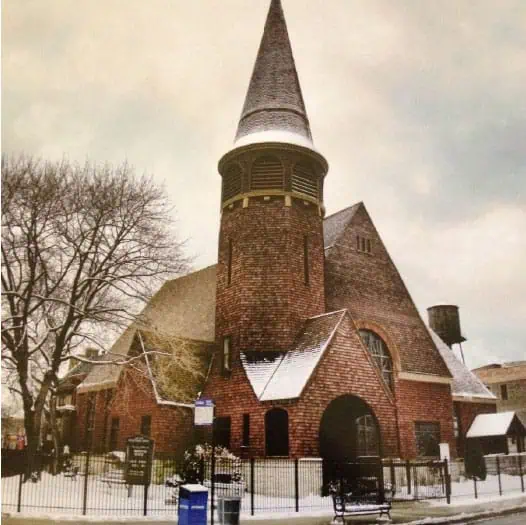
Lakeview Presbyterian Church, Chicago, 1888
The real boom in Chicago took place in its famous downtown “loop.” As the city’s population more than doubled from 500,000 in 1880 to 1.1 million in 1890, land prices in the loop rose from $130,000 per quarter acre in 1880 to $900,000 ten years later. To get the most revenue from their office buildings, developers needed to go higher. A new word entered the language, “skyscraper,” at first used as a pejorative referencing men’s arrogant desire to touch the heavens. The major cities of Europe had enacted height limits to prohibit such ideas, but in the United States, the emphasis on individual and private property rights prevented that from happening.
Because buildings were built of masonry, the only way to support the weight of a tall building was to have very thick walls, which were thickest on the ground floor. Windows had to be narrow, letting little light into the offices, and on the ground floor, smallest of all, just where the street-level retail tenants wanted big windows. There was also the challenge of lighting large interiors and convincing office tenants to walk up nine or ten stories (heights reached in the 1870s) to their offices. If one had to contact someone in another tall office building, he had to walk down those floors, down the street, then back up again. Bell’s innovation of the telephone in 1876, Edison’s electric light bulb of 1879, and the electric elevator that premiered in 1889 worked together to make skyscrapers more practical, but they still needed those thick walls.
In 1881, through their Chicago friend, real estate lawyer Owen Aldis, Dan and John were introduced to the wealthy Brooks brothers of Boston, Peter and Shepherd, who speculated in Chicago real estate and developed office buildings. Peter was the driving force and the more adventurous of the two. He gave the Chicago architects the commission for the ten-story Montauk and other office buildings in the loop.
Peter Brooks was a stickler for details. There should be no projections on the outside of his buildings that might catch dirt and lead to higher maintenance costs. He took out the plans to put cabinets under the bathroom sinks, as they were just places where dirt and mice could gather. The less plumbing the better, as that was always a cause of trouble—and the plumbing should be clustered into the same areas on each floor. Every pipe must be accessible for repairs, openly visible, but “painted well and handsomely.” Big panes of glass must be divided into two parts so they were less expensive to replace. The building must be as fireproof as humanly possible. Light courts would be used to get the most daylight into each office. Dan Burnham learned a great deal working with Brooks. The two men shared a deep pragmatic streak.
Burnham and Root even developed a new type of “floating raft” foundation for the massive Montauk structure built on the soft, damp Chicago soil: a 20-inch-thick slab of concrete under the entire building, strengthened with steel rails. In later years, better drilling and drainage methods allowed Chicago buildings to put their foundations down to bedrock, below the wet soil. In order to give Brooks the most for his money, they continued construction work on the Montauk through the winter, which was rare at the time. They covered the entire project with a huge canvas and put heaters inside for the workforce.

Montauk Building, Chicago, completed 1882
While Burnham and Root designed and built many office and commercial buildings in Chicago, one of their best was the Rookery, built from 1885 to 1888, for Peter and Shepherd Brooks. At 11 stories, it was larger and taller than any other Chicago building. Many consider this the firm’s masterpiece. At the time, architecture critic Thomas Tallmadge wrote, “an architectural tour de force. . . . the first modern office building plan . . . the problem of arrangement of light courts, of corridors, of stairs, and the division of offices were for the first time intelligently solved.” The beautiful building continued to be a prestigious office address into the twenty-first century.

The Rookery, Chicago, 1888
At this time, buildings were still built using masonry and thick walls. Steel was too expensive and had not been tested. In the 1870s, the open-hearth steelmaking process made it possible to lower the price of steel. A few architects took a chance on the new idea, a building that was basically a steel cage, with the walls in effect “hung” off the steel structure rather than bearing the building’s weight on their own. William Le Baron Jenney’s Home Insurance Building of 1883–85 was the first “metal cage” skyscraper. However, Burnham and Root’s 1888–90 Rand McNally building, built for the large map and railroad publishing and printing company, was the first building in the world to be completely supported by an all-steel frame, as well as the first skyscraper with an all terracotta (baked clay) façade.
The period of 1890–92 saw the two partners build many buildings in Chicago, including the Great Northern Hotel, the Women’s Temple, and the Masonic Temple, the first 20-story building in Chicago. Their reputation continued to spread, leading to the Mills building in San Francisco and the Equitable building in Atlanta.
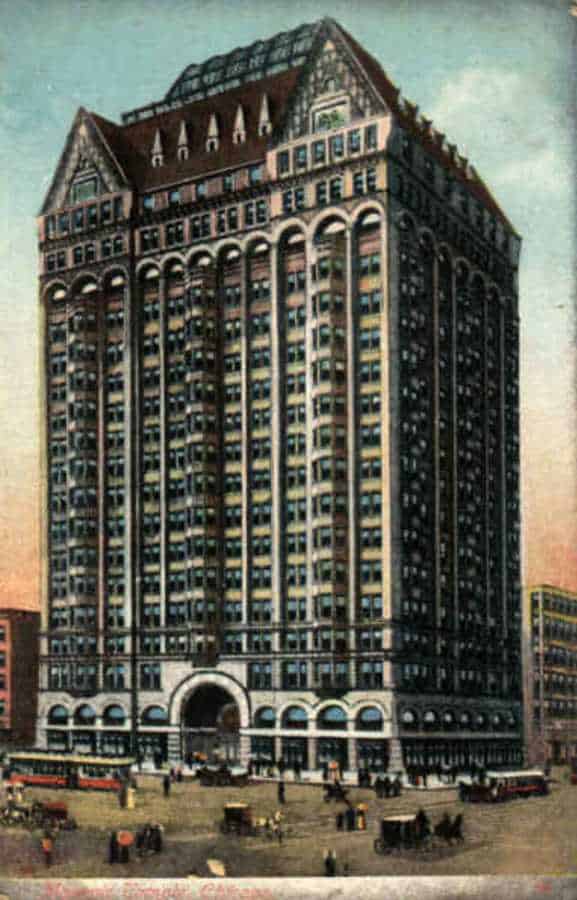
Masonic Temple, Chicago, 1892

Monadnock Building, Chicago, 1892
In that same year, the firm built the last big masonry building, the 16-story Monadnock, as requested by the more conservative Shepherd Brooks. She still stands and is on the architecture tours of the loop alongside other Burnham and Root buildings.
As the firm completed these buildings, they often moved their offices to one of their new ones: to the Montauk in 1885, then to the top floor of the Rookery in 1888. Dan Burnham always wanted a view, a way to see “the big picture.” Having worked for or with many prominent architects, the two men became active in professional organizations. Dan felt the American Institute of Architects (AIA) was too focused on the East Coast, so he founded the Western Architects Association in 1884. Five years later, it had become important enough that the two organizations merged into the modern AIA.
Of course, home life continued apace. In the 1870s and 1880s, Dan and Margaret had five children:
John, Ethel, Hubert, Margaret, and Daniel Jr. As his income rose, Dan no longer wanted his children to “run in the streets of Chicago” and bought a farmhouse on Lake Michigan in Evanston. Over time, he expanded and improved the property, where the family often held social events, hiked, and swam in the lake.
Birth of the World’s Fair
In 1851, a great exposition was held in London, featuring an enormous “Crystal Palace.” Britain showed off the latest technologies and products, the results of British industrialism. This is generally acknowledged as the first World’s Fair. Cities and nations around the world picked up on the idea. By 1890, there had been close to 30 such fairs, including major ones in Philadelphia for the 1876 Centennial and in Paris in 1889, which drew enormous crowds. The Paris fair was centered on the new Eiffel Tower, which was built by Gustave Eiffel as a privately financed tourist attraction. It remained the tallest manmade structure in the world for the next 41 years, until the Chrysler Building in New York was finished.
While the industrial revolution may have begun in England, it moved the furthest and fastest in the United States, where such ideas as interchangeable parts and mass production were developed and in wide use. By 1890, the U.S. was no longer a poor cousin, a secondary state, but was becoming a world power. Our leaders wanted to produce an unprecedented World’s Fair to celebrate the 400th anniversary of Christopher Columbus’s 1492 arrival, but more importantly, show the world the arts, sciences, and industries of America. By the late 1880s, there were bids by Washington, New York, Chicago, and St. Louis to host the fair. The mayor of Chicago appointed a committee of 250 leading citizens to work on the project.
Chicago was in the best location to draw a crowd from around the country, amplified by the fact that most of the major railroads came together in the city. In April 1890, after Congress acted, President Harrison signed an act to hold the “international exhibition” in Chicago. However, no federal funding came with the passage of the act, so Chicago was on its own to finance, build, and carry out the fair. A governing board of 45 leading Chicago businessmen was formed. At the time, it was estimated that the fair would cost $5 million to build and operate, but that those 45 men had a combined wealth of $70 million. The organizers sold stock in the fair company in order to finance it, with everyone from regular citizens to the railroad companies contributing.
As a first step, the Chicagoans hired Frederick Law Olmsted, the foremost American landscape designer, responsible for New York’s Central Park and the Biltmore estate in North Carolina, to lay out the grounds. They soon retained Burnham and Root as “consulting architects.” These men then chose Jackson Park, on Lake Michigan on the south side of Chicago, as the best site. Given how important the fair was, how much it would cost, how much was riding on it, and how politicized the process was, every step was met with discussion and sometimes fierce debate. But few men were as convincing and as enthusiastic as Dan Burnham.
By the fall of 1890, Burnham, Root, Olmsted, and Olmsted’s younger associate Henry Codman had laid out the overall design of the fair, with sizes and locations for each building. In November, the national commission appointed in Washington approved the plan. Daniel Burnham was named chief of construction, later to be called the director of works, while John Root remained a consulting architect. Such was the faith in Burnham that he was allowed to become “a demanding but benevolent dictator.”
Other architects in Chicago and back east thought that Burnham and Root would get all the architecture jobs at the fair, but that was not what Dan had in mind. Not taking pay for himself, which was his usual practice when working on civic projects, he wanted only the best possible architecture. And given the tight time frame—it took them until the spring of 1893, a year late, to build the fair—he needed plenty of talented people to work on the project.
He suggested to the Fair Buildings and Grounds Commission, to which he reported, that they had four options for the design of the fair buildings: (1) select and use one architecture firm, (2) open all the work up to architectural competitions and pick the winners for each building, (3) select a group of architects and let them compete, or (4) pick a small group of the best architects and let them figure it out. Burnham advocated for the fourth choice, narrowly winning the contentious debate.
Dan and John then selected Richard Morris Hunt; George B. Post; and the firm of McKim, Mead, and White, three of the most venerable New York firms. They added Peabody and Stearns of Boston and Van Brunt and Howe of Kansas City to their list. Later in the process, due to complaints by Chicago architects, they added a group of prominent local architects to the list, including Adler and (Louis) Sullivan, Burling and Whitehouse, Jenney and Mundie, Henry Ives Cobb, and Solon S. Beman. Over time, the group added artists like the sculptor Augustus St. Gaudens and painter Frank Millett, who both became close friends of Dan Burnham.
In December 1890, Burnham sent letters to each of these men to encourage and assess their interest in participating. Only Van Brunt in Kansas City responded with a yes, so Dan hit the road (really the rails, as he loved to travel by train) and gradually sold each of these great architects on participating in the Chicago project. He became close, lifelong friends with most of them, further increasing his personal circle (and influence). Note that many of these men had studied at the famous Ecole des Beaux Arts in Paris, traveled the world studying buildings, and often had architecture degrees or engineering degrees from the best universities. Dan Burnham had none of those, just his ability to persuade and his ability to deliver.

The architects: Burnham, in the middle, circled in red. Three prominent New Yorkers, marked in blue, left to right: chairman of the group, Richard Morris Hunt; George Post; and standing with the pointer, Charles McKim. In yellow is Lyman Gage, the Chicago businessman who chaired the overseeing Buildings and Grounds commission. And in green, left to right, the oldest man in the room, 68-year-old Frederick Olmsted; Louis Sullivan; and one of the youngest, Henry Ives Cobb, age 31. Dan Burnham was 44 at the time.
On a cold January day in 1891, Burnham hosted the whole group on a tour of the Jackson Park site. John Root was suffering from a cold and stayed home. Some of the architects said the fair could never be built in the allotted time, to which Dan responded, “It is settled.” Once he had a goal in mind, nothing could stop him.
After the site tour, the Roots hosted the visiting architects in their home. John’s condition worsened into pneumonia, and he asked Burnham to stay after the reception. Within hours, John Root was dead, at the age of 41. Daniel Burnham was beyond distraught, reportedly screaming in his agony, “I have worked, I have schemed and dreamed to make us the greatest architects in the world. I have made him see it and kept him at it—and now he dies! Damn! Damn! Damn!”
Even greater than the damage to their partnership was Burnham’s personal loss of his best friend. Dan Jr. later said that he didn’t think his father ever completely got over the loss. Some observers, who saw Root as the creative genius and Burnham only as a salesman and promoter, thought it might be the end of Burnham’s success.
While Dan quickly replaced (or tried to replace) Root with others, starting with Charles B. Atwood, who died four years later, he never again had a partner with such talent and influence. Yet he had no choice but to continue working on the fair and making it the best he could.
The World’s Columbian Exposition, Chicago, May-October 1893
Dan Burnham always felt the need to be “onsite.” For the fair, he set up a camp and offices at the fair site in Jackson Park. He moved there, often having his children visit him at his new temporary home. There were drafting rooms, offices, a gym for the fitness-obsessed Burnham, and bunks for the architects and engineers. In the evenings, they would gather around the fireplace and talk into the night, usually aided by wine (though Dan was not a heavy drinker) and described as “jovial affairs.”
The task before them was almost unimaginable, to clear the swampish land, build all the buildings, some of which required unprecedented feats of structural engineering, all in less than two years. The enormous buildings were built to be temporary, out of a material called staff made of cement, plaster, and jute fiber. The architects created molds for the staff to mass produce building decorations and developed new methods of spray painting to get the job done quicky and efficiently.
Burnham had to continually ride the architects and engineers to keep them on schedule and resolve the many disputes and sometimes personal quarrels that arose. He also had to deal with the various commissions and committees of the fair (technically including his bosses), with visiting royalty, and with the ever-interested press. He began each day at daybreak with a tour of the entire 600+ acre grounds, as the fair would be the largest one ever held. Each day ended with a full staff meeting. No detail missed his keen eye. He negotiated labor relations with the thousands of construction and other workers. He helped design the medals to be awarded at the fair. When planners and workers became discouraged, they relied on Burnham’s willfulness and enthusiasm to get back to work.
In the midst of that grind, Dan took the time to attend a massive banquet at New York’s Madison Square Garden in his honor. The president of Harvard attended, along with authors, architects, artists, and the press. The fair would make Dan Burnham an international celebrity, and over his lifetime, he met virtually every powerful person in the United States, befriending presidents, especially Teddy Roosevelt.
The design of the fair itself was largely “neo-classical,” as Burnham and the other architects felt the columns and decoration of the Greeks and Romans had withstood the test of time and were “accessible” to the general public. The central Court of Honor was a lagoon with large white buildings on all sides. The press labeled the fair as “the White City.” Away from the Court, more diverse buildings spread out among landscaped lagoons designed by Olmsted, full of natural areas and even a wooded island. On the west side, away from the lake, was the first “Midway,” full of entertainment like the Streets of Cairo, where the famous belly-dancer “Little Egypt” performed (over the objections of the women’s board). A new pier extended 1,000 feet into Lake Michigan.


The workforce required to build and operate the fair
It is almost impossible today to envision the scope and beauty of the fair. The largest building, for manufactures and the liberal arts, was more than 1 million square feet, over 30 acres, the largest building in the world. It was covered by a high steel structure that tested the limits of engineering skill and construction. An “intramural” railway ran around the periphery of the fair, allowing easy transportation. The Illinois Central Railroad, the Chicago street cars, and the “Alley elevated” all connected to the fair in newly built stations. Using George Westinghouse and Nikola Tesla’s innovative AC electrical system, the fair was brightly lit, using three times as much electricity as the rest of Chicago combined.

On May 1, 1893, President Cleveland hit the telegraph key that turned on the electricity and opened the World’s Columbian Exposition to a crowd of 300,000, reportedly the largest single gathering in U.S. history up until that time. Over time, almost every American who could afford to travel to Chicago and pay the 50-cent admission price attended, including Thomas Edison and Henry Ford. New products and ideas, including Cracker Jack and the zipper, premiered at the fair. H. J. Heinz had one of the most successful exhibits. Americans were introduced to Zen Buddhism and the cultures of the world for the first time. Among the most visible items was George Ferris’s giant wheel.
After the initial crowd at the May opening, traffic was soft for a few weeks, but then people began to return home and tell their friends about it, and attendance boomed. By the end of the five-month run, 27 million people had attended the fair, in a nation of just 65 to 70 million—an incredible “market penetration.” The busiest week, in October, drew over 2 million visitors. The fair was also one of the very few in history to actually make a profit, under the wise administration of Dan Burnham and his colleagues.
Hundreds of books were published in conjunction with the fair (many are available for free on Google books), and many more have been published since. There are also some excellent videos, especially the PBS documentary Expo—Magic of the White City. Erik Larson’s 2003 book, The Devil in the White City: Murder, Magic, and Madness at the Fair That Changed America, became a bestseller, focusing on Dan Burnham and the serial killer H. H. Holmes, who owned a cheap hotel near the fair, preying on visiting single women. Given the wealth of available information and images, here we present a small, selective taste of what the fair looked like.


Chicago Day drew the biggest attendance, over 700,000 visitors in one day

The Railroad Station for the fair, serving 18 million visitors

The Court of Honor


Manufactures and Liberal Arts Building

Manufactures and Liberal Arts Building

Louis Sullivan’s Colorful Transportation Building

Palace of Fine Arts Building, now the Museum of Science and Industry, and the only major building remaining today

The Midway

Cairo on the Midway

The Ferris Wheel

The Ferris Wheel

The Intramural Railway

The Fair at Night

The Fair at Night

The Fair at Night

Typical events during the Fair

After the Fair: Planning Cities
Dan’s firm, now renamed D. H. Burnham and Company, took few new commissions during the fair development period, working on buildings they had already begun. When Burnham got back to the office, the firm continued to build large projects around the nation, and Burnham continued to organize and promote the architecture profession. His new reputation based on the fair also placed him in demand as a planner, at a time when there was no such profession as “city planner.” The firm grew to a staff of 180 people and may have at one point been the largest architectural practice in the world “under one roof.” By his death, Daniel Burnham and his associates, before and after John Root’s death, built at least 500 buildings.
Now a celebrity, in 1894, Burnham received honorary degrees from Harvard and Yale, schools that had rejected him years earlier. In 1893 and 1894, he was elected president of the American Institute of Architects. As much as he loved the attention, getting awards was not foremost in the man’s mind. Burnham thought our buildings and cities could be far more beautiful. Actions inspired by the fair and his later work were called “The City Beautiful Movement.”
Since the 1880s, Burnham had been concerned that the federal government was not doing its part to make America beautiful. The government rarely employed talented architects, instead relying on a poorly paid and understaffed national supervising architect who reported to the penny-pinching, conservative Secretary of the Treasury, John Carlisle. Dan and a few other architects began a campaign to change things, including lobbying the President and any legislator who would listen to him. After years of lobbying, in 1893, Congress passed the Tarsney Act, which encouraged holding open competitions among architects for federal work.
But nothing changed, as Carlisle and the supervising architect took no action on the act’s provisions. Burnham fired off increasingly irritated letters to those in power. Finally, Carlisle had enough and wrote to Burnham, “You are informed that the department will have no further correspondence with you upon the subject to which it (your letter) relates, or any other subject.” Most men with a good job and full life might have given up, but not Dan Burnham. He turned all that correspondence over to the New York Times, saying the problem was “the result of installing a small man in a large place.” Architects, the press, and the public at large were on Dan’s side.
Then, with the election of McKinley in 1896, everything changed. He installed a “big man,” Burnham’s Chicago friend Lyman Gage, as the Secretary of the Treasury. The four-year-old Tarsney Act was finally put into place. Top sculptors, painters, and architects soon joined the cause and began to impact government architecture.
With his now-strong Washington connections, it was natural for the government to turn to Burnham when they wanted an updated plan for the District of Columbia. The beautifully designed city had been laid out by the architect Pierre L’Enfant in 1791, but no further major plans had been made since then. In 1901, the senator who chaired the District of Columbia committee, James McMillan, called on Burnham to “pick up where L’Enfant left off,” which is what Burnham and his associates did. Burnham called in his friend Charles McKim and, as landscape architect, Frederick Law Olmsted’s son. They first traveled to Europe to study the great capital cities. As soon as they sailed from America, Dan gathered the group to start working on the plan.
The men proposed draining the rough swamp near the Potomac and creating recreational fields for the citizens. After clearing the swamp in that part of the city, they proposed placing the planned Lincoln Monument in the same area. Dan and friends fought battles at every turn, one observer thinking, “The ideas were too overpowering to receive consideration in Congress.”
Powerful Congressman Joe Cannon of Illinois fought the plans the hardest, saying, “So long as I live, I’ll never let a monument to Abraham Lincoln be erected in that Goddamn swamp!” The fiery remarks did not stop Dan’s continuous salesmanship. In 1922, the Lincoln Memorial opened right where Dan said it should be. The plan called for the reflecting pool between the Washington and Lincoln monuments and a bridge at the west end, to Alexandria, Virginia.

A huge obstacle was the Pennsylvania Railroad, the main way that people from Baltimore, Philadelphia, New York, and New England arrived in Washington. Their station was right on the National Mall in the midst of other buildings, and Congress had given them broad powers. Burnham believed the station needed to be moved off to one side, near the Capitol. He also believed this was a great opportunity to present a wonderful entryway to the nation’s capital. Pennsylvania Railroad President Alexander Cassatt, busy building the Hudson tunnels and Penn Station in New York, had no interest in moving the station. Yet again, Dan convinced Cassatt of the wisdom of his plan, and his firm designed one of America’s showplaces, a new Washington Union Station.


Exterior and interior views of Union Station, Washington, DC
Most of the plans were carried out, including new House and Senate office buildings and the idea of clustering important buildings into groups. Dan Burnham never lost touch with his friends in Washington. In 1910, President Taft created a permanent Fine Arts Commission, naming Dan Burnham the chairman.
The Washington project and travel overseas were critical to Burnham’s education as a city planner. And with that education and experience came an international reputation and more cities asking for his help, which he always provided at no income to himself, although he made sure his staff were paid.
Urban reformer and Cleveland Mayor Tom Johnson came to Dan next, who chaired another group of designers for the project. While some parts of the final 1902 plan were done, Burnham’s major idea to relocate the railroad station to the lakefront was never achieved. In each city, there were always factions, including politicians, landowners, and real estate developers, who fought any change.
Next came San Francisco in 1904. At the request of the city’s civic leaders, Burnham arrived in May and spent the next several weeks exploring the area, being feted at dinners, and discussing the possibilities. He brought out his associate Edward Bennett and set up a camp on Twin Peaks, the highest point in the city, to have the best overview of San Francisco and its flow.
In the midst of the project, he sailed for the Philippines—that story comes next—spent six weeks in Asia, and then returned to work with Bennett on San Francisco. In September 1905, the planners submitted their report on remaking the city. After approval, it is believed that the final public document was printed and ready to be distributed on April 18, 1906. That was the day of the great San Francisco earthquake, and the story goes that all those copies were lost on that terrible day.
In any case, political and commercial exigencies caused the city to drop all plans and rebuild in a helter-skelter way. San Francisco proved a missed opportunity to rebuild along a logical plan. Among Burnham and Bennett’s ideas, only the stepped terraces and circular drive of Telegraph Hill were carried out.
After the Spanish-American War, the U.S. took control of the Philippines. The government and military authorities wanted the islands to have a beautiful capital as well as a new “summer capital” in the country’s highlands. After some discussion, Secretary of War Taft approved hiring Burnham, saying, “He is too good a man to lose.”
Burnham, his wife, his daughter, and friend Edward Ayer sailed for Asia in October 1904 and spent six weeks there, along with Burnham’s lead designer, Pierce Anderson. The trip changed Dan Burnham’s perspective on the world and its cultures. It resulted in plans for the capital Manila and the new city Baguio, all of which were carried out. Baguio still has a Burnham park and monument at its center.

Burnham monument in Baguio, Philippines
Dan never charged for his services on these projects.
Burnham continued to receive requests to help plan cities around North America, from Montreal to Tampa. Amherst College and the University of Illinois both requested help planning their campuses. But as he aged and slowed down a bit, he had to turn down these offers, over 20 of them. He was quick to recommend friends for the tasks, especially his associate Edward Bennett, who got planning jobs in Minneapolis, Duluth, and Portland.
After the Fair: Building America
Given how busy the man was planning cities on his own time and money, one might think that the architectural firm D. H. Burnham and Company might have suffered, losing its top salesman and doing little work. But under Dan’s energetic, organized leadership, the firm not only survived but prospered, as it continued to do beautiful work around America. From 1891 through 1912, the firm built more than 200 buildings.
The rising stars at the firm were Ernest Graham, who after 1908 oversaw the entire operation; his associate designer Pierce Anderson; chief of working plans Edward Probst; and chief of superintendence/construction H.J. White. The firm also opened offices in New York and San Francisco.
Major projects started or built under Dan’s watchful eye included Chicago’s Field Museum of Natural History (not completed until 1920), Union Station in Washington, and the Frick building in Pittsburgh. The firm had a specialty in “large retail stores” and designed and built the Marshall Field store on State Street in Chicago, Filene’s in downtown Boston, Wanamaker’s in the center of Philadelphia, and Gimbel’s New York at Herald Square—a block from Macy’s. The Marshall Field store was particularly beautiful, with the biggest Tiffany stained glass mosaic ceiling in the world. When the Wanamaker store opened, President Taft attended the dedication ceremony.
Marshall Field’s former associate, Harry Gordon Selfridge, moved to London and brought the idea of the big American department store to that country. He enlisted Burnham to design the store, but British rules prohibited the use of an American architect, so Dan could only advise on the great store Selfridge built in London.
Work on office buildings, railroad stations, houses, and other building types continued apace. Yet another great success was New York’s Fuller Building, which has become one of the firm’s most famous works under the colloquial name “the Flatiron” building.

Field Museum of Natural History, Chicago

Marshall Field (now Macy’s), State Street Chicago

Marshall Field (now Macy’s), State Street Chicago

Wanamaker’s, Philadelphia

Flatiron Building, New York
The Plan of Chicago
As much as Dan loved planning all those cities, of course his heart was always in Chicago. How might the city be made more beautiful and livable? As in all his plans, Burnham considered the needs of the average citizen—did they have access to parks? In a lakefront city like Chicago, did they have public beaches? Did the transit system and flow of traffic make sense? Where should heavy industries and factories be located? Was there enough housing? As early as 1896, Dan had suggested a lakefront park system and South Shore Drive, gaining enthusiasm from such civic leaders as meatpacker Philip Armour, merchant Marshall Field, and sleeping car king George Pullman.
In 1901, Burnham joined the Commercial Club of Chicago where further discussions on planning took place. Six years later, nothing had moved ahead but interest was revived. Dan and Edward Bennett began their studies, surveying over 20 cities including Paris. They also discussed their ideas with every faction and interest group in Chicago. On July 4, 1909, the Commercial Club finally published their beautifully illustrated and now famous Plan of Chicago.
Burnham and the Commercial Club went to great lengths to promote the plan. In order to develop support across the community, civic leader Charles H. Wacker created a textbook for eighth-grade civics classes that explained the plan.
Over the next 20 years, the city spent over $300 million carrying out parts of the 1909 plan. While the grand civic center was never built, completed parts include the public lakefront park system with accessible beaches, a ring of forest preserves around the edges of the metropolitan area, the development of North Michigan Avenue and opening of the Michigan Avenue bridge over the Chicago River, and upper and lower Wacker Drive.


The End
In the spring of 1912, Dan and Margaret again sailed for Europe, on the new ship the RMS Olympic. As they departed New York, Dan knew that his dear friend and painter Frank Millett was just returning from Europe on a sister ship to the Olympic, so he cabled Frank to welcome him home. Word came back that the cable could not be sent, as Millett’s Titanic had hit an iceberg. Frank was among the many lost in the disaster.
In Heidelberg, Dan Burnham got food poisoning, complicated by his own diabetes. He died there on June 1, 1912, at the age of 65. His beloved Margaret Sherman Burnham lived on until 1945, age 95.
Dan the Man
While some great entrepreneurs and business leaders have been so focused on their work that they had little outside or personal lives, that wasn’t true of Daniel Burnham. With his prodigious creation of buildings and plans, it is almost hard to imagine how he also had time for family, friends, recreation, and hobbies, but he did.
Always first and foremost in his mind were his family and friends. He loved Margaret and the children, swimming in Lake Michigan, going on sleigh rides, and writing his family hundreds of letters when they were apart. As he became wealthy, he readily shared that wealth. It was said that he was, “Especially kind to his less affluent brothers and sisters and nieces and nephews.”
Burnham’s generosity was not restricted to relatives. He was always ready to serve as a reference for those seeking jobs. After John Root died, Dan financed most of his son’s education. John Root Jr. went on to be a prominent architect with the major firm of Holabird and Root. Dan offered the young and rising Frank Lloyd Wright, who went on to become America’s most famous architect, a full expense-paid six-year education in Paris and Rome, followed by a job working for Dan, but Wright turned him down.
His charitable contributions were diverse, the largest ones being the American Academy in Rome that he helped found, Harvard University, and the Chicago Symphony Orchestra.
Burnham was above all else a social being. It seems that hardly a day went by that he wasn’t at a banquet, club meeting, or talking to his friends all the way up to Roosevelt and Taft. He loved good company and a good time. Dan golfed and played bridge with his many friends.
His avocations were varied in the extreme. He loved the outdoors, camping, and fishing with friends. After the Fair, especially in the late 1890s, he and the family began to explore the world, venturing as far as Carthage, Cairo, and Istanbul. He was moved by the classical architecture of Rome and Greece, saying, “I have the spirit of Greece once and forever stamped on my soul.”
Dan continually rode trains and traveled across America, visiting the Grand Canyon and Mexico. On almost all those trips, he and Margaret (and sometimes their children) traveled with friends, often prominent Chicago businessmen and their wives.
Burnham “loved gadgets and exalted in the wonders of technology.” He gave one of the wonders of the late-nineteenth century, the Gillette safety razor, as a gift to friends. He noted in his diary each time one of them bought an automobile, of which he owned several, including a $1,500 custom Locomobile. He also “loved to shop for rugs and furniture at Marshall Field’s.”
Dan was never far from music, hosting quartets of the Chicago Symphony at his home. He also loved opera, ballet, and the theater. On the artistic side, Burnham painted and made drawings as a hobby and collected paintings. He had a large library and was a voracious reader of history, literature, art, maps, magazines, and newspapers.
Underlying this fulsome life was his belief in Swedenborgian principles. Dan Burnham studied the Bible and conducted Sunday services at his home.
Legacy
The pictures we have shown in this article are enough to demonstrate the impact of Daniel Hudson Burnham on our “built environment.” Millions of people have enjoyed Chicago’s lakefront park system, admired the Flatiron building, entered Washington through Union Station, shopped in the department stores he designed, or worked in one of his buildings.
As the twentieth century unfolded, the architectural community became fascinated with new architectural styles, including purely American idioms not borrowed from Europe, and new ideas from Europe such as the “modern architecture” of the German Bauhaus. Architecture writers and critics looked back on the neoclassical buildings of the Fair and the Chicago plan with disdain, sometimes seen as symbols of imperialism. One of those writers who objected the most was Burnham’s old friend Louis Sullivan, who built far fewer buildings but became a hero to the critics. In the 1920s, Sullivan wrote a scathing attack on Burnham and his projects and the “damage” they did to American architectural progress. For decades, very little was written about Dan Burnham; he became “the bad guy.” Academics and architectural scholars gave him little attention. (Sullivan, financially unsuccessful, slid into alcoholism. Despite their differences, Dan Burnham reportedly helped Sullivan out.)
In the last 20 to 30 years, Burnham’s reputation has been revived. It became hard to ignore the impact the man had or that his buildings, even at 100 years old, were still standing, still functional, and often beloved by those without (or with) a degree in architecture. The 100th anniversary of the World Fair in 1993 was followed by the 2009 centennial of the Plan of Chicago. As a result, there are now more books, documentaries, and online sources about Dan Burnham and his projects. Historians have taken a more balanced view of his life and achievements.
As the proud founder and builder of a large architectural organization, Dan Burnham had to be satisfied with the business he left behind. Renamed Graham, Anderson, Probst, and White after Dan’s death, the firm continued to be one of the largest architectural firms in the world. His sons joined the firm before leaving to go on their own in 1917.
The firm continued to build department stores and railroad stations across the country. In the 24 years following the death of Dan Burnham, the firm completed something like 700 projects. The number of important and large buildings they created indicates that Dan Burnham’s successors never lost sight of his goal to do “big things.”
Sources and further reading: This article is based on the excellent biography of Burnham, “Burnham of Chicago: Architect & Planner,” by Thomas S. Hines (second edition, 2009). The other standard biography of Burnham, written by a colleague and less balanced, is “Daniel H. Burnham: Architect Planner of Cities,” by Charles Moore (two volumes, 1921, also available as a 1968 reprint by the De Capo Press). A wonderful full-color “art book” of his work is “Daniel H. Burnham: Visionary Architect and Planner,” by Kristen Schaffer and others (2003). An excellent video documentary on Burnham and his life is “Make No Little Plans: Daniel Burnham & the American City (2010).” The story of the firm after his death is best told (and fully illustrated) in “Architecture and Planning of Graham, Anderson, Probst, and White, 1912–1936,” by Sally A. Kitt Chappell (1992).
There are too many books on the history of World’s Fairs and the Columbian Exposition specifically to list here. Many of the original books and guides published at the time are available as PDFs. A good serious reference book on all the fairs is “Encyclopedia of World’s Fairs and Expositions” by John E. Findling and Kimberly D. Pelle (2008). Author Robert Rydell has written several books on the World’s Fairs in America. For imagery of various fairs, an excellent book is “World’s Fairs” by Erik Mattie (1998). For colored images of the Chicago World Fair, search for books by Mark Bussler. Memorabilia from all the fairs can often be found on eBay.
The original Plan of Chicago has been reprinted multiple times, one of the best being “Plan of Chicago: Centennial Edition” (2009), published by the Great Books Foundation and supported by the Commercial Club of Chicago, the original sponsors of the fair. Copies of the original plan itself, full of beautiful renderings, generally sell for about $2,500. Author Carl Smith’s “The Plan of Chicago: Daniel Burnham and the Remaking of the American City” (2006) is the best book on the plan, its context, and impact.
Lastly, there is of course a multitude of books on Chicago architecture, on skyscrapers, on railway stations, and on the great architects themselves. For Chicago building history, look for books by Carl W. Condit and Frank A. Randall, as well as the “AIA Guide to Chicago” (fourth edition, 2022), the outstanding and comprehensive “Chicago: Growth of a Metropolis” (1969) by Harold M. Mayer and Richard C. Wade, and the two fully illustrated volumes on “Chicago Architecture” (1987 and 1993) by John Zukowsky and published by Prestel for the Art Institute of Chicago.
Gary Hoover is a business history fellow at the Archbridge Institute and lead author of the institute’s popular “American Originals" series. He is the rare combination of a business scholar and practitioner. He has a bachelor’s degree in economics from the University of Chicago, where he studied under four Nobel laureates. He has served as an Entrepreneur-in-Residence at the University of Texas in Austin and the University of Texas at Austin, and he is a fellow of the IC2 Institute. He speaks to conferences and corporate groups and works to encourage innovation and entrepreneurial thinking on every continent and in every industry, for-profit and not-for-profit.
Share:
Related Posts