

From Ideas to Innovation:
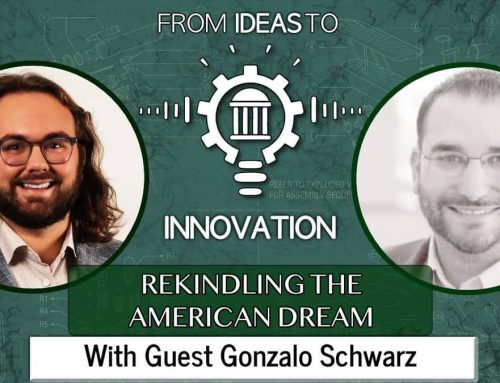
Welcome to Episode 9 of From Ideas to Innovation.
I’m sitting down with a good friend and collaborator, prolific economist, and professor at George Mason University to discuss his upcoming book, The Great Enrichment. Vincent Geloso takes on one of the most contested periods in American economic history, arguing that what actually happened was almost the opposite of what we’ve been told.
This is one of the most intellectually fun conversations on this podcast. Buckle up and get ready to shift the way you’ve heard the historical narrative.
Vincent Geloso didn’t dream of being an economist. He planned to study art history — until his father pointed out the distinction between a hobby and a job.
So he started by dabbling in politics, landing a summer internship in the Canadian Prime Minister’s office in Ottawa as one of the very few French-speaking Conservatives from Quebec. He tried journalism next. Neither stuck.
Then, in the final year of his undergraduate degree at the University of Montreal, he took a class he’d been avoiding: Leonard Dudley’s Economic History of the Western World. A quarter of the way through the semester, he knew exactly what he wanted to do with his life.
Since then, Vincent has built one of the most prolific careers in economics, with over 120 peer-reviewed papers on topics spanning economic history, inequality, public choice, and social mobility. He has written on everything from the economics of lobotomies to why lighthouses aren’t public goods. As a professor at George Mason University, he is one of the most distinctive voices in his field — a true economic historian who can speak both the language of an economist and that of a historian.
His upcoming book, The Great Enrichment, is the culmination of years of research into what actually happened to living standards in America from 1865 to 1945 — and why the standard account gets it so badly wrong.
Read highlights from the interview.
From Ideas to Innovation with Justin Callais
Share:
Related Posts


Related Posts