

OVERVIEW
Childcare regulations aim to overcome information and measurement problems in the childcare market. However, state and federal regulations can have unintended consequences such as limiting supply, raising prices, and slowing new innovation. Childcare regulation is just one area of occupational licensing that affects American workers. About 25 percent of all professions require some kind of government approval to be practiced legally.
The 2026 edition of the State Childcare Regulations Index mirrors the state-level analysis of childcare regulation highlighted in 2024 by the Knee Regulatory Research Center. For the index, we consider state policies and regulations for center-based childcare facilities, including child-to-staff ratio requirements by age, maximum group sizes by age, required annual training hours for staff, and minimum educational requirements for center directors and lead teachers.
A previous edition of this index employed data released in 2013 by advocacy organization Child Care Aware. For this edition, we used data collected in 2025 by the Archbridge Institute (State Childcare Regulations Database 2025) and affiliates at the Challey Institute for Global Innovation and Growth at North Dakota State University. Because of these changes in data collection, we caution readers not to assume any changes in ranking from the 2024 edition can be exclusively attributed to changes in regulatory policy.
There are two potential avenues to improving access to childcare for American families. One is to meet the higher prices and shortages resulting from increased barriers to entry with subsidies and state-sponsored programs. New Mexico is taking this path and plans to offer free childcare to all residents as of November 2025. The alternative path, and the path that involves addressing the drivers of high childcare prices, is regulatory reform. Providers in Virginia recently expressed the burdensome nature of ever-increasing regulations on day-to-day operations, many of which are inflexible to the needs of the children and families they serve.
The variation across states illustrates that there is no single model of childcare regulation in the United States. The State Childcare Regulations Index offers a way to evaluate the trade-offs between regulatory intensity and access to care. By tracking how regulatory regimes evolve over time, policymakers and researchers can better understand how policies shape the childcare market.
RESULTS
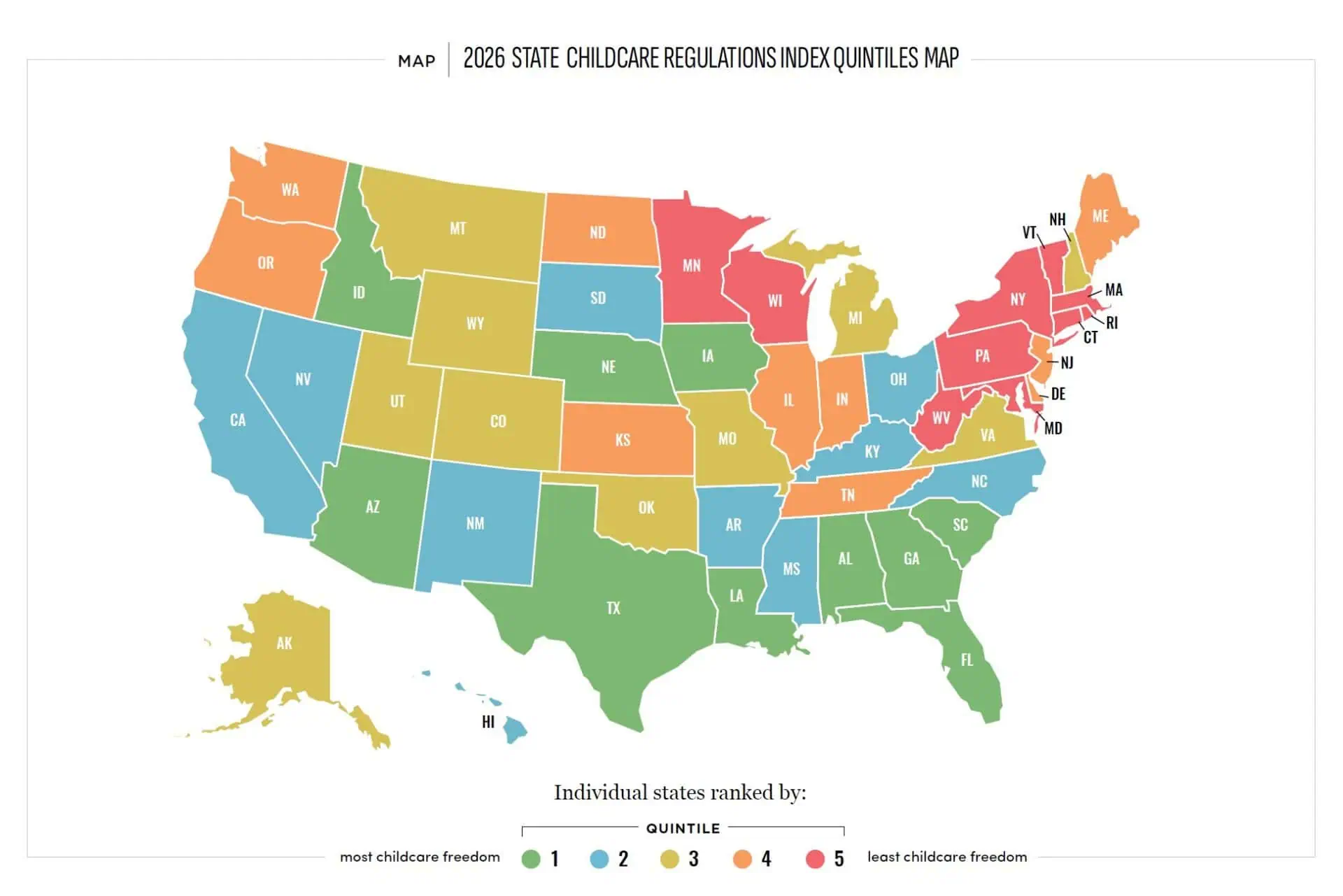
Childcare regulation is one example of a policy area where states demonstrate different levels of economic freedom—limited government oversight over market interactions. Following the example set by the Fraser Institute’s Economic Freedom of the World Index, our index scores all 50 states based on their licensing standards, where states with more freedom (less stringent regulations) receive higher scores.
The state with the most childcare freedom and the lowest regulatory burden is Idaho (#1), followed by South Carolina (#2), Arizona (#3), Alabama (#4), and Florida (#5); the state with the least childcare freedom and highest regulatory burden is Vermont (#50), preceded by New York (#49), Pennsylvania (#48), Maryland (#47), and Massachusetts (#46).
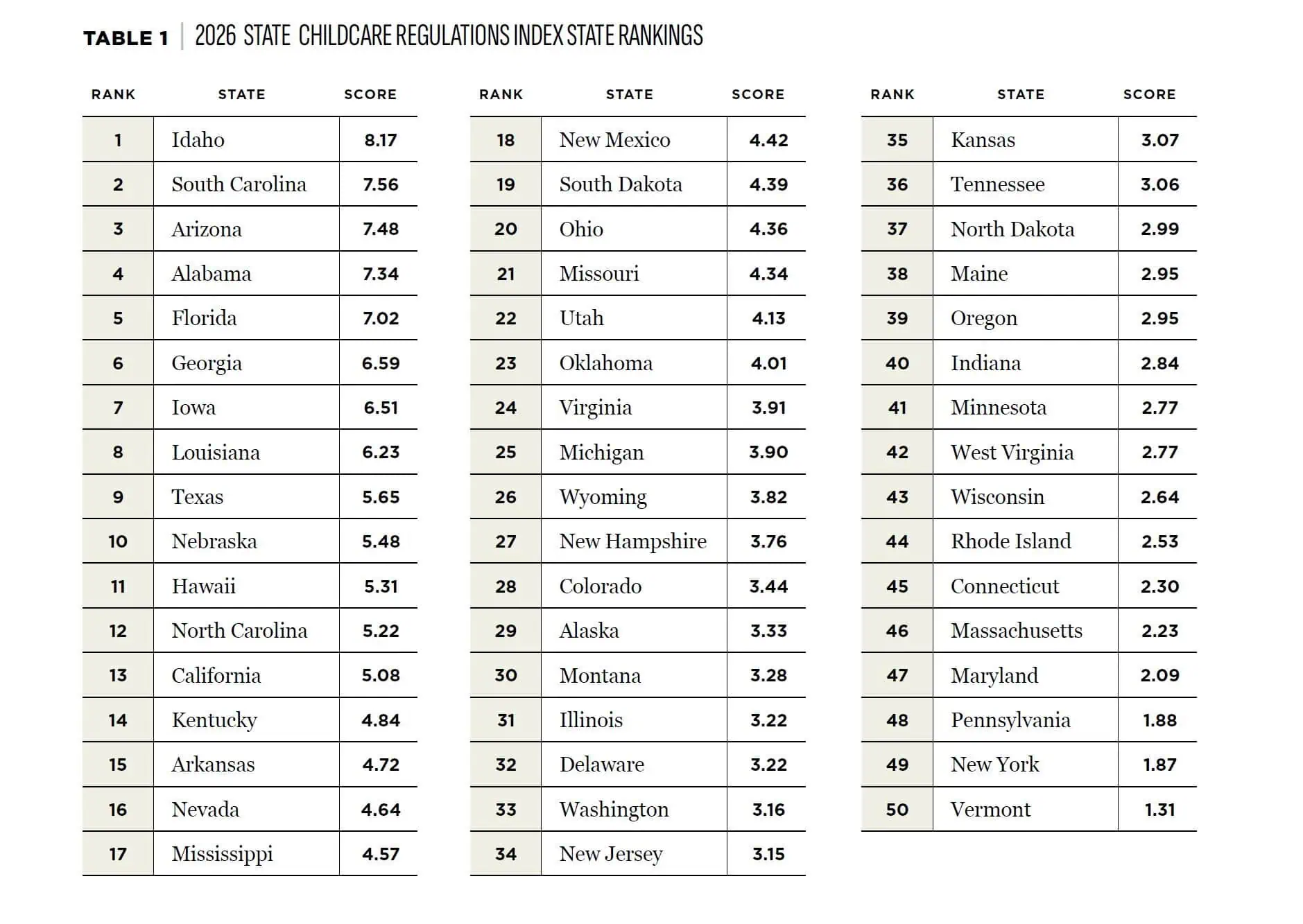
State Profiles
Each state profile features its overall childcare freedom score, national and regional rankings, and rankings for the four sub-components: child-to-staff ratio, maximum group size, annual staff training hours, and education requirements. We highlight the level of regulatory consistency on a scale of low-medium-high, and we call attention to each state’s most and least stringent regulation.
Interactive Map: Click on a state to see its childhood freedom score and rankings.
- West South Central
- East South Central
- South Atlantic
- Pacific
- Mountain
- West North Central
- East North Central
- Middle Atlantic
- New England
From the authors:
Before improving access to affordable childcare for American families, we first need to study the variation across states and evaluate the trade-offs between regulatory intensity and access to care. The 2026 State Childcare Regulations Index offers a blueprint for researchers and policymakers to study the status quo and come up with meaningful regulatory reforms. Rather than pursuing costly taxpayer-funded subsidies and state-sponsored programs, we recommend reducing regulatory burdens on childcare providers that ultimately harm parents by increasing barriers to entry and raising the cost of childcare. On the issue of childcare, a more affordable America means a less regulated America—from one state to the next.
Data
The State Childcare Regulations Database is available here. For questions or inquiries about the index dataset, please contact Ricky Feir at richard.feir@ndsu.edu.
Share:
Related Posts