
Discover How Your State Ranks
Find out how your state ranks in the State Childcare Regulations Index 2026 from the Archbridge Institute. We interviewed Ricky Feir a research specialist at the Sheila and Robert Challey Institute for Global Innovation and Growth at North Dakota State University and a coauthor of the report. He unpacks the key takeaways for regulatory agencies from the report, specifically the impact of child care regulations on the cost and availability of child care.
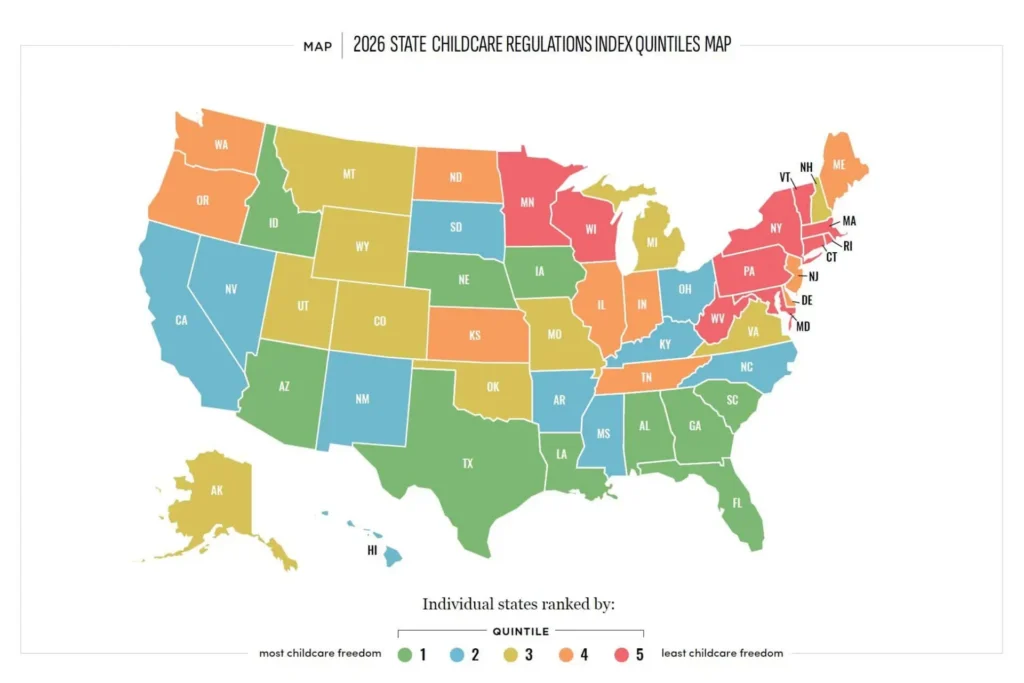
The second edition of the Childcare Regulation Index ranks states from most childcare freedom to least childcare freedom. In the report, for example, Idaho ranks first, as the state with the most childcare freedom, while Vermont ranks last, as the state with the least child care freedom. In addition to a numbered rank, the research also places each state in one of five “quintiles,” color coding them from the least to most freedom on a U.S. map.
For the index, the Archbridge Institute explains they reviewed state policies and regulations for center-based childcare facilities, including child-to-staff ratio requirements by age, maximum group sizes by age, required annual training hours for staff, and minimum educational requirements for center directors and lead teachers.
“This index serves as a tool for state lawmakers to compare themselves to one another and analyze whether the policies they have in place are truly helping providers and families,” says Feir. “The science shows that, especially in low-income areas, costs increase and availability decreases with stringent regulations.”
Q&A with Report Coauthor Ricky Feir
Explain what the 2026 State Childcare Regulations Index measures and clarify what a higher or lower score indicates.
The 2026 State Childcare Regulations Index measures how strict or burdensome childcare regulations are for each state in the year 2025. A high score indicates a relatively free state with a low regulatory burden while a low score indicates a state with low freedom or a high regulatory burden.
Identify patterns among states ranking higher or lower in the index.
The five most free states had no group size maximum across ages. Child-to-staff ratios were also comparatively high among these states. The least free states had low maximum group sizes and child-to-staff ratios while having high educational requirements.
Explain how a higher or lower state score impacts residents seeking child care services.
The existing academic literature shows that stricter maximum group sizes, child-to-staff ratios, and education requirements increase the cost of childcare and decrease the availability of childcare. Research does not convincingly show that higher regulations increase the quality of outcomes for children.
Share insights from the report that guide child care agency leaders in modernizing licensing, inspections or compliance oversight.
If regulations were simplified and made more consistent across states, childcare costs would decrease and availability would increase. This would encourage entrepreneurship in childcare and allow providers to retain their most talented teachers.
Describe the most practical way for a state child care agency to use the information in the report.
This index serves as a tool for state lawmakers to compare themselves to one another and analyze whether the policies they have in place are truly helping providers and families. The science shows that, especially in low-income areas, costs increase and availability decreases with stringent regulations.
Any additional information/insights to share?
Over the past decade, states have increased the regulatory burden on childcare centers. We know this increases the cost and decreases availability of childcare. It’s time to look honestly at how these regulations have limited opportunities for families with young children while not necessarily improving quality.
This article was originally published by GL Solutions.
GL Solutions
Share:
Related Posts



Related Posts
None found