
From Freedom & Prosperity Radio:
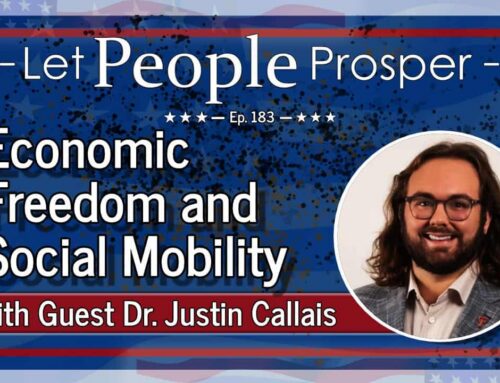
This episode of Freedom and Prosperity Radio, produced by the Virginia Institute for Public Policy, features an in-depth discussion on social mobility with Justin Calais, chief economist at the Archbridge Institute and author of a comprehensive report analyzing social mobility across all 50 U.S. states. The dialogue explores the concept of social mobility, its measurement, and the factors influencing it at the state level, emphasizing the role of institutions, policies, and community engagement.
Social mobility is defined as the ability of individuals and families to improve their economic and social status over time, typically across generations. Calais illustrates that in a dynamic free market system, wealth and status are not fixed; families wealthy in 1960 are generally not the same as those wealthy in 2020, demonstrating economic fluidity. The U.S. system ideally facilitates this mobility through entrepreneurship, education, and human capital development.
The Archbridge Institute’s Social Mobility Index evaluates states based on four pillars: entrepreneurship and economic growth, legal system quality, education and skills development, and social capital/community engagement. The findings reveal significant disparities among states. Utah ranks highest due to effective policies like its innovative “one-door” welfare system, which streamlines assistance and encourages self-improvement. Conversely, Louisiana, New York, Alabama, and Mississippi rank lowest, hindered by regulatory burdens, ineffective welfare structures, and socio-economic challenges.
Virginia falls near the median in the index, ranking 24th. While Virginia performs reasonably well in judicial system quality, education quality, and family stability, it struggles with stringent occupational licensing policies that inhibit economic opportunity for lower-income individuals. Although efforts toward expanding vocational training and school choice show promise, barriers such as licensing and regulatory restrictions limit social mobility.
The conversation also touches on broader systemic issues, such as federal welfare policies creating “donut holes” where individuals earn slightly more but lose benefits, thus disincentivizing upward mobility. The discussion highlights the tension between good intentions in social safety nets and bureaucratic inefficiencies that can inadvertently trap people in poverty.
The episode concludes with a call for states to adopt more effective policies modeled after successful examples like Utah’s welfare system and to continue reforming occupational licensing and education to foster greater opportunity and prosperity.
Listen to the full episode here.
Virginia Institute for Public Policy
Share:
Related Posts