

Introduction
In the mid-1970s, a group of Chilean economists trained at the University of Chicago, known as the “Chicago Boys,” assumed key policymaking roles under Chile’s military government. They launched an ambitious set of free market reforms: privatizing state-owned enterprises (including in manufacturing, banking, and copper), liberalizing international trade, eliminating price controls, introducing school vouchers and local control in education, promoting competition in health care, curtailing fiscal spending, granting independence to the central bank, and reforming labor and pension systems.
These changes are often credited anecdotally with Chile’s transformation from economic stagnation to the strongest performer in Latin America—the so-called “Chilean Miracle.” Yet rigorous causal evidence has been limited. This policy brief summarizes new research that quantifies the long-term economic impact of these reforms using the Synthetic Control Method (SCM). The analysis constructs a “synthetic Chile” from a donor pool of 82 countries that closely matches Chile’s pre-reform macroeconomic and political characteristics. Any post-1982 divergence between actual Chile and this synthetic Chile isolates the effect of the Chicago Boys’ policies.
The results matter for citizens and policymakers worldwide. They demonstrate that widespread pro-market reforms centered on economic freedom, competition, and reduced government intervention can generate substantial, sustained gains in living standards, even in challenging political contexts. Chile’s experience provides a compelling case study for nations considering liberalization to foster prosperity.
Key Findings
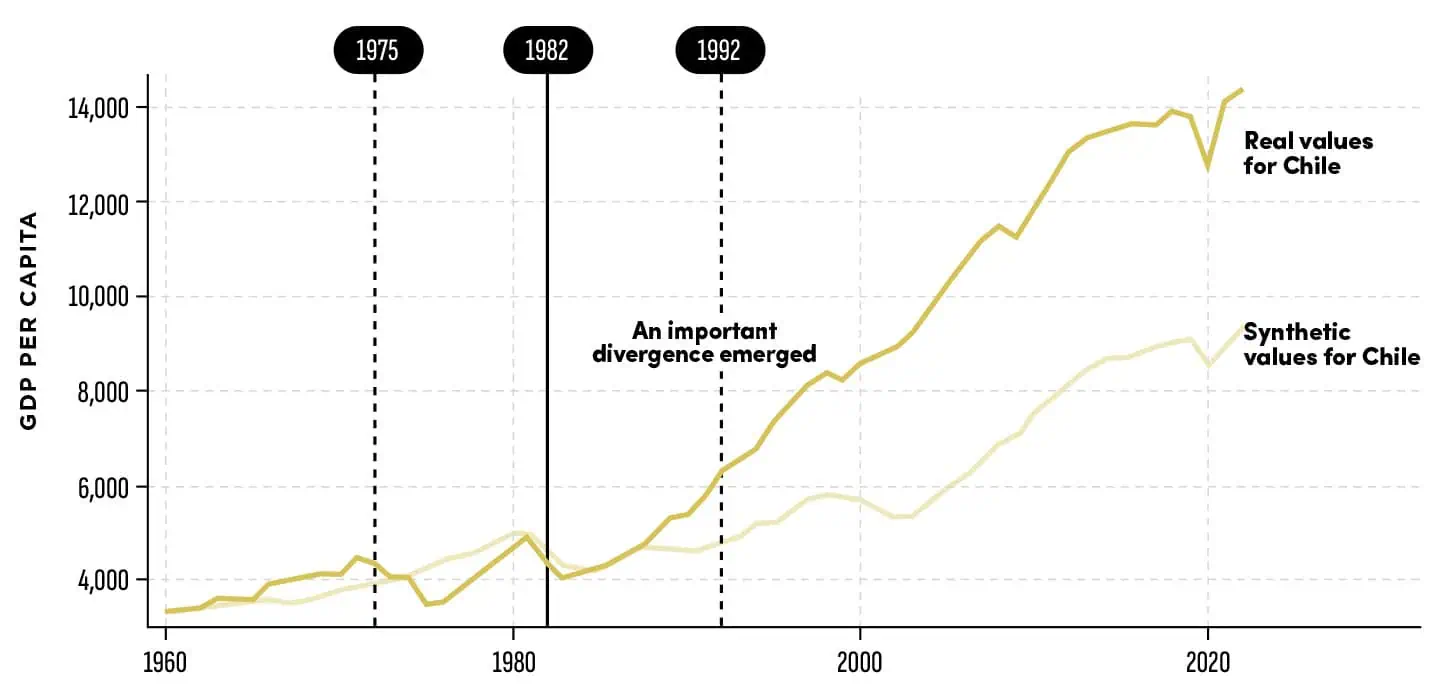
- The Chicago Boys’ reforms began modestly in the late 1970s but accelerated sharply around 1982. Using 1982 as the treatment year, our estimation shows that Chile’s GDP per capita closely tracked its synthetic counterpart through the early 1980s. A clear and growing divergence then emerged.
- By 1992, Chile’s GDP per capita was approximately $1,429 higher than the synthetic counterfactual. This represents a 30% increase.
- By 2019, the gap widened to roughly $4,667, representing a 41% increase in GDP per capita.
- These gains are robust across numerous sensitivity checks and are statistically significant.
- Importantly, the analysis separates the effects of the Pinochet dictatorship from the market reforms. Prior to 1982, when the military regime pursued centralized planning, Chile’s economy underperformed its synthetic counterpart (a roughly 17% reduction in GDP per capita by 1981). Growth accelerated only after the Chicago Boys’ policies took hold. The free market orientation, not authoritarianism, drove the prosperity.
Policy Recommendations
- Prioritize broad economic liberalization packages over piecemeal changes. Comprehensive packages create complementary effects and signal credible commitment to markets.
- Expand choice and competition in education and healthcare. Policymakers can reduce barriers to entry and empower individuals with choice through voucher systems, local control, and increased competition in education and healthcare.
- Privatize state-owned enterprises and reduce bureaucratic size. Governments should pursue transparent privatization and fiscal restraint to free resources for productive private use.
- Maintain central bank independence and sound monetary/fiscal policy. Institutional safeguards against political interference in money and budgets are essential to stabilize macroeconomic policy.
- Liberalize trade and investment flows. Pursue open trade policies and direct foreign investment to boost growth; avoid protectionism.
Summary
Chile’s experience with the Chicago Boys demonstrates that bold, pro-market reforms deliver large and lasting improvements in economic wellbeing. These gains were not the product of dictatorship but of the specific policies that increased economic freedom, competition, and individual choice.
The observations of Chile coincide with the measurable benefits from market liberalization in former Soviet Republics, such as Georgia, and ongoing benefits in modern-day Argentina.
Policymakers seeking higher living standards, greater opportunity, and human flourishing should look to Chile as evidence that reducing barriers to enterprise and empowering citizens through market-oriented institutions works. The Chilean Miracle is replicable where governments have the courage to implement similar reforms.
Source: McCannon, Bryan C. and Bira Zhahadai. 2026. Chicago Boys. Eastern Economic Journal. Forthcoming.
Share:
Related Posts



Related Posts
None found