The need for occupational licensing reform has emerged as one of the few topics where one can read a statement from former President Obama and current President Trump on the subject and not be 100 percent sure who authored the comment. The Bureau of Labor Statistics using Current Population Survey data now produces regular estimates of the fraction of the U.S. workforce that has an occupational license, and we now know that more than 21 percent of U.S. workers have an occupational license. We also have excellent new historical data on occupational licensing restrictions provided by Nicholas Carollo that should only further advance the stylized fact that the costs of occupational licensing outweigh any of its benefits.
Despite all of these advancements, reform efforts remain slow and minor. Arguments continue to be put forth that we need occupational licensing to keep people safe. Research on how licensing impacts quality produces mixed outcomes at best (see Morris M. Kleiner and Maria Koumenta, eds., Grease or Grit?: International Case Studies of Occupational Licensing and Its Effects on Efficiency and Quality [W. E. Upjohn Institute for Employment Research, 2022]) and part of the challenge is properly quantifying quality.
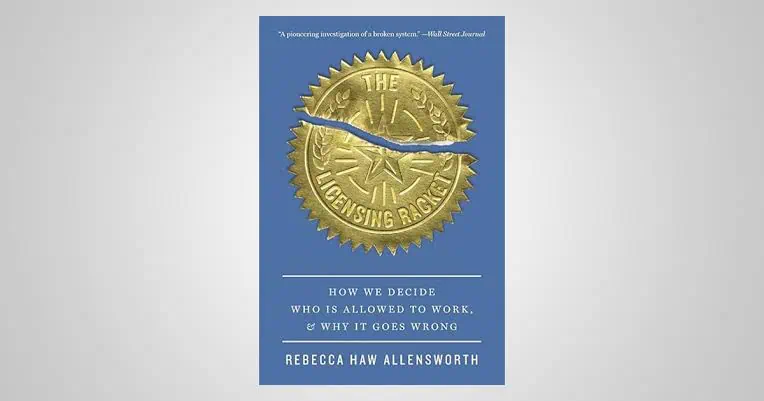
Rebecca Haw Allensworth tackles this question head on and spends most of her time in the book talking about doctors and lawyers, not hair braiders and interior designers. Unlike previous books that focus more on data and empirical analysis, Allensworth regularly attended licensing board meetings and actually talked to people “interviewing more than 180 people involved in the regulation of twenty-eight professions” (p. 14). Her book is mostly focused on her home state of Tennessee, but it is clear that her findings and recommendations have clear policy implications nationally. The book is also carefully and diligently researched and it is very clear that she has an outstanding grasp of the existing academic literature on the effects of occupational licensing.
Similar to great work that I admire by groups like the Institute for Justice and Pacific Legal Foundation, Allensworth shares compelling stories of licensing creating unnecessary barriers to human flourishing: a licensed barber from Michigan who could not pass Tennessee’s licensing exam without an interpreter and was thus barred from working and a hair braider who had to work underground as a result of the state’s costly licensing regime. But the most significant contribution of this work is its diligent reporting on occupational licensing repeatedly failing to live up to its stated purpose of protecting public welfare. Even more compelling is the book’s focus on the professions where arguments surrounding the public safety benefits for occupational licensing are the easiest to make and believe.
Continue reading at the Independent Institute.
Edward Timmons, PhD, is Vice President of Policy at the Archbridge Institute. He leads the institute's economic policy strategy, identifying focus areas and disseminating work to key stakeholders and policymakers. His own research focuses on labor economics and regulatory policy; he is regularly asked to provide expert testimony to U.S. states on occupational licensing reform and the practice authority of nurse practitioners. Dr. Timmons received his Ph.D. in economics from Lehigh University and his B.A. in economics and actuarial science from Lebanon Valley College. He publishes a weekly newsletter on Substack with the latest research and policy insights surrounding occupational licensing.
Share:
Related Posts



Related Posts
None found