


Overview
When people think of the American Dream, they consider the ability to better one’s life and achieve one’s goals. They are either directly or indirectly speaking about social mobility. In this index, we examine differences across the 50 states in providing an environment where citizens can pursue and reach their individual dreams, through the lens of social mobility.
A concern for social mobility is shared across the entire political spectrum. The idea that people’s socio-economic position should not be fixed by dint of birth finds little to no opposition. However, debates emerge when the time comes to measure social mobility and to define the policies that promote it.
While there are many ways to measure income mobility, we still have a rudimentary understanding of the barriers that prevent social mobility. Here, we take social mobility to be a broader way of thinking about people’s ability to improve their own lives and well-being, which includes but is not limited to income.
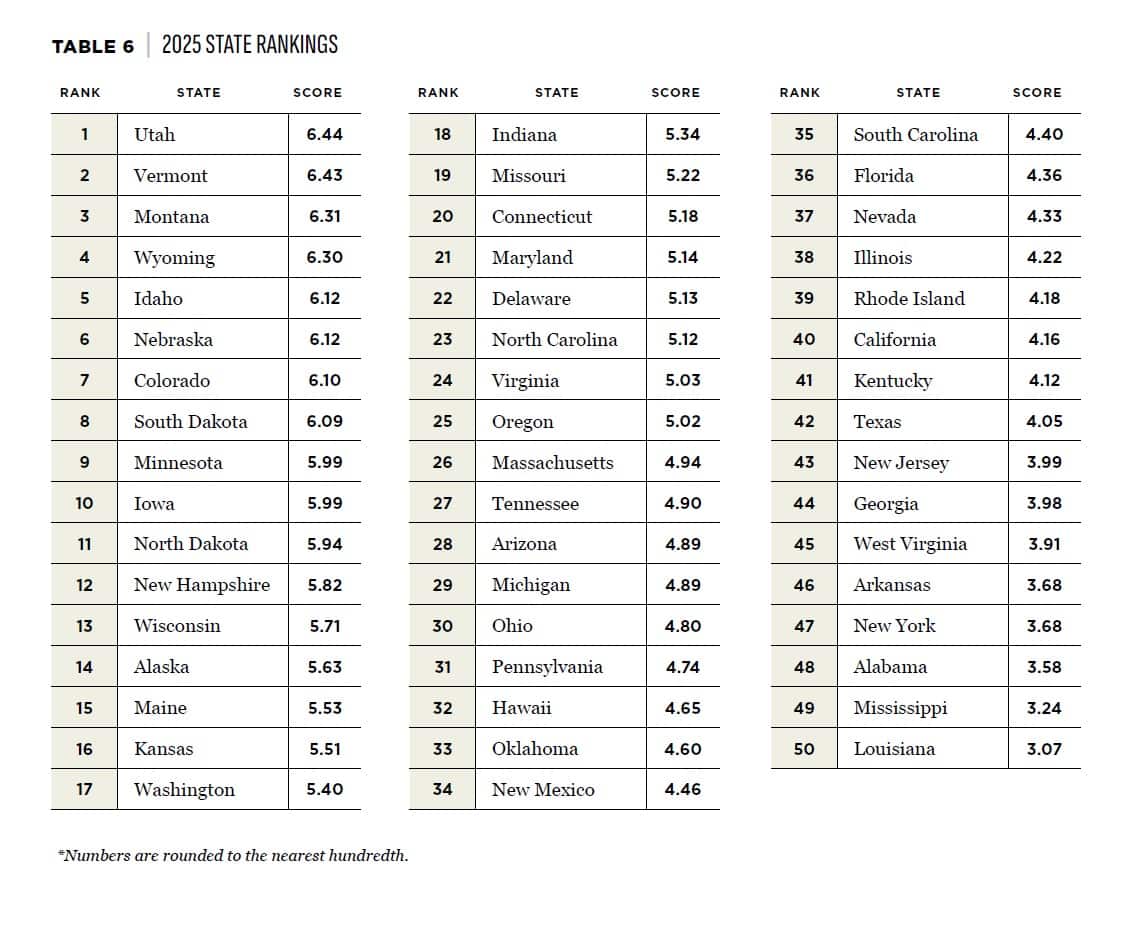
Social Mobility in the 50 States: In this index, we rank all 50 U.S. states from best (#1) to worst (#50) based on their overall score for social mobility. Higher scores represent a better environment for social mobility and a better rank.
Four Pillars of Social Mobility: To rank each state, we measured a series of indicators related to social mobility across four pillars: Entrepreneurship and Growth, Institutions and the Rule of Law, Education and Skills Development, and Social Capital. Scores for each pillar were combined and weighted equally to create a state’s overall social mobility score.
Barriers to Social Mobility: People face barriers to social mobility across their lifespans. Artificial barriers are imposed by external forces and can be addressed with public policy, while natural barriers occur at the individual level and often require different interventions. One of the main objectives of this index is to generate a satisfactory taxonomy on the main barriers and leading indicators of social mobility.
Comparisons to Other Measures: We present evidence that our index correlates strongly with other measures of income mobility, income inequality, and poverty.
2025 Edition: In 2025, the state with the best environment for social mobility is Utah (#1), followed by Vermont (#2), Montana (#3), Wyoming (#4), and Idaho (#5); the state with the worst social mobility outlook is Louisiana (#50), preceded by Mississippi (#49), Alabama (#48), New York (#47), and Arkansas (#46). Overall, states in the Mountain and Central regions generally perform well, while states in the South and Middle Atlantic regions have higher barriers to social mobility.
The first edition of this index was released in 2023. For the 2025 edition, we added measures for median home prices, energy and electricity costs, and childcare regulations.
2025 STATE RANKINGS
Interactive Map: Click on a state to reveal its social mobility rankings.
- West South Central
- East South Central
- South Atlantic
- Pacific
- Mountain
- West North Central
- East North Central
- Middle Atlantic
- New England
Each state profile features a breakdown of its overall and individual scores, a regional comparison, and key findings. This information provides useful insights for researchers and policymakers.
From the authors:
Everyone intuitively understands the importance of social mobility; it is the idea that a person’s success should not be determined at birth, but rather by his own agency, opportunities, and hard work. But what enables social mobility, and what barriers lead to entrenched poverty? And how does that environment break down by state? That is what we explore in this report, and we hope states will see their ranking as a guide on how to help more people flourish.
– Justin Callais, lead author of Social Mobility in the 50 States
America was founded on the promise of freedom and the American Dream, and we need to understand where the 50 U.S. states stand on keeping that promise. By studying all 50 states, we have found where the dream is most possible and what work still needs to be done as our nation approaches 250 years since the Declaration of Independence was signed.
While states like Utah have emerged as role models for the rest of the country, states like Louisiana are in desperate need of public policy reform that can lift the barriers to human flourishing. Beyond public education, Archbridge’s ‘Social Mobility in the 50 States’ index is a message to policymakers in both parties that we have much more work to do for all Americans.
– Gonzalo Schwarz, co-author of Social Mobility in the 50 States
Share:
Related Posts